Office Acoustic Zoning in Malaysian Corporate Spaces: How Sound Mapping Improves Focus, Privacy, and Collaboration in 2026
A practical guide for Malaysian companies to use sound mapping and acoustic zoning as strategic design tools. Learn how quieter focus areas, protected private spaces, and intentional collaboration zones can improve workplace performance.
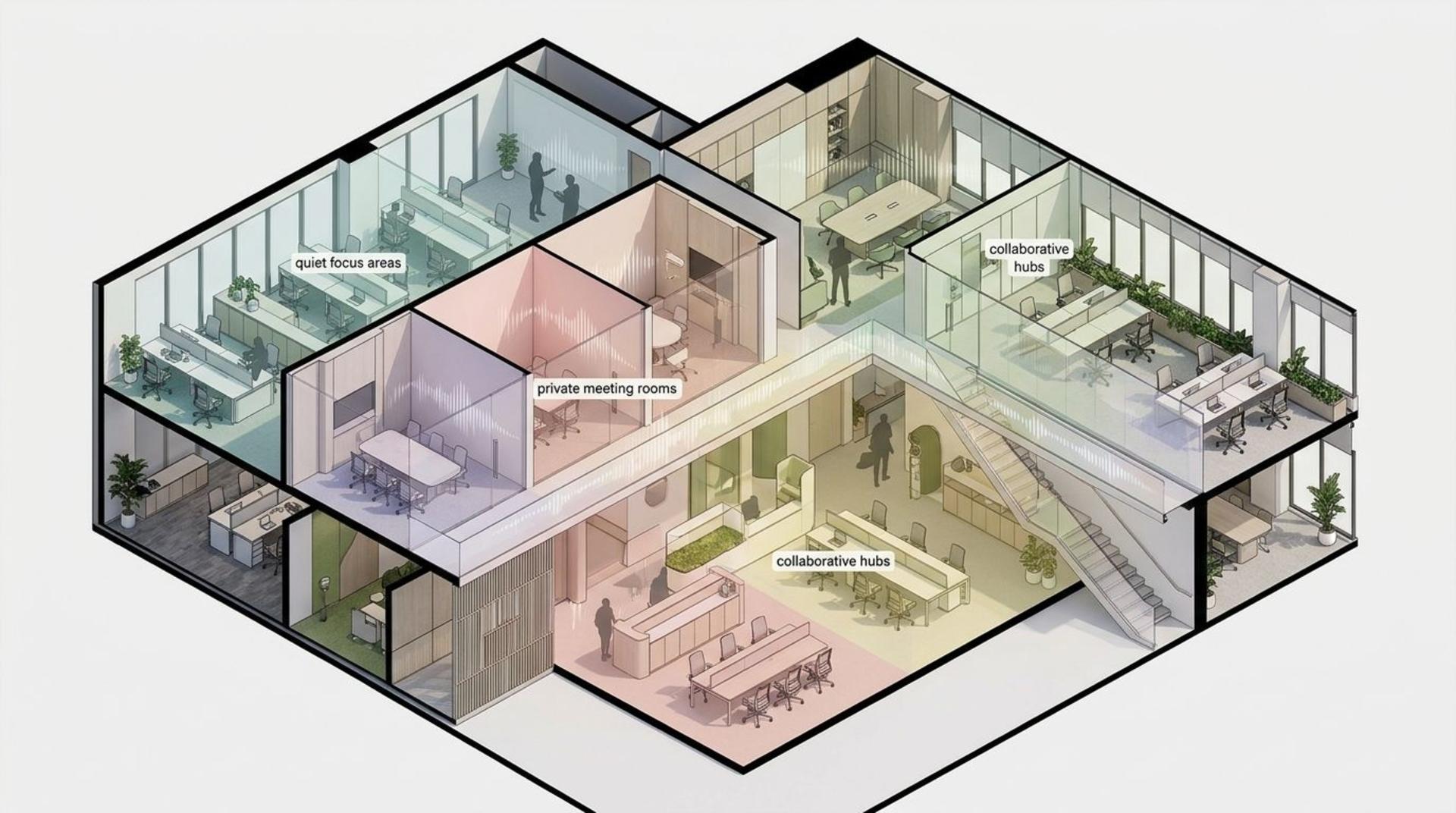
Title: Office Acoustic Zoning in Malaysian Corporate Spaces: How Sound Mapping Improves Focus, Privacy, and Collaboration in 2026
Subtitle: A practical guide for Malaysian companies to use sound mapping and acoustic zoning as strategic design tools. Learn how quieter focus areas, protected private spaces, and intentional collaboration zones can improve workplace performance.
The modern Malaysian corporate workspace has undergone a radical transformation. Gone are the days when simply knocking down walls to create a sprawling open-plan layout was considered the peak of office design. As we step deeper into 2026, companies in Kuala Lumpur, Penang, and Johor Bahru are realizing that visual aesthetics alone are no longer enough to sustain a high-performing workforce. The invisible element of design—sound—has taken center stage.
Today, acoustic zoning stands as a critical, non-negotiable layer of workplace strategy. Companies are discovering that controlling the ambient soundscape dictates how employees feel, function, and collaborate. By utilizing advanced sound mapping technologies, corporate leaders are transforming chaotic, echoing offices into perfectly tuned environments. This guide explores the strategic integration of sound mapping and acoustic zoning, detailing how Malaysian businesses can cultivate quiet focus, ensure speech privacy, and foster seamless collaboration without sacrificing the visual appeal of their interiors.
Why Acoustic Zoning Matters More in Malaysian Offices in 2026
Just five years ago, commercial design firms in Kuala Lumpur were hyper-focused on "visual openness." The prevailing strategy featured minimal partitions and vast, sleek floor plans. The underlying assumption was that office noise was merely a cultural habit, something to be managed by employees themselves rather than addressed through physical architecture. However, this oversight led to sensory overload, proving that an office cannot function effectively if everyone is forced to hear everyone else.
In 2026, the paradigm has shifted toward specialized "activity-based zoning," where silence is treated as a premium product. Businesses now understand that a standardized acoustic environment fails an increasingly diverse workforce. Rather than designing spaces uniformly, companies are differentiating zones by their specific sound profiles. For example, quiet blue zones are engineered for heads-down tasks like coding or deep writing, while vibrant red zones are tailored for high-energy brainstorming and interactive meetings.
This evolution is fundamentally rooted in a growing awareness of varying employee needs. We are now acknowledging that neurodiverse employees, in particular, require highly controlled, predictable acoustic environments to thrive. By prioritizing how a space sounds just as much as how it looks, Malaysian corporate spaces are finally aligning human wellbeing with architectural design.
What Sound Mapping Reveals About Workplace Behavior
To fix bad office acoustics, you must first understand where the noise is coming from. Sound mapping is the analytical process of measuring and visualizing acoustic patterns across a physical space. Using specialized software and decibel meters, designers can track how sound waves travel through open-plan desks, bounce off walls, and leak from supposedly sealed meeting rooms.
What sound mapping consistently reveals is that noise doesn't just travel in straight lines—it pools, echoes, and reverberates. A sound map might show that a high-traffic circulation path is bleeding disruptive chatter directly into a primary workstation area. It might reveal that the lively energy of the pantry is echoing down the hallways and ruining the concentration of employees seated forty feet away.
More importantly, sound mapping highlights the true behavior of the workforce. It shows where people naturally congregate, where they retreat when they need to take an urgent phone call, and where they avoid sitting altogether because the ambient noise is deeply uncomfortable. By interpreting this data, businesses can translate invisible acoustic flaws into actionable, highly targeted zoning decisions that align the physical space with actual human behavior.
The Hidden Cost of Poor Acoustics: Distraction, Fatigue, and Privacy Loss
The consequences of ignoring office acoustics go far beyond mild annoyance. There is a tangible, measurable cost attached to poor sound management, affecting both the wellbeing of staff and the financial bottom line of the business. The primary culprit is cognitive fatigue. When an employee is forced to tune out background conversations, ringing phones, and clattering keyboards, their brain is constantly expending energy to filter out the noise. Over an eight-hour workday, this drastically degrades focus, leading to a higher rate of errors and a dramatic drop in overall productivity.
Furthermore, poor acoustics lead to a severe loss of privacy. In environments where speech intelligibility is high (meaning you can clearly make out the words being spoken by a colleague across the room), employees feel exposed. They hesitate to have candid conversations, conduct sensitive client calls, or brainstorm freely, out of fear of being overheard.
This chronic lack of privacy and constant distraction ultimately damages morale. Employees may start seeking excuses to work from home simply to find a quiet corner. Over time, the hidden cost of a noisy layout manifests in lower employee retention, decreased creative output, and elevated stress levels.
How to Define Focus Zones, Collaboration Zones, and Transition Areas
Creating an effective acoustic ecosystem begins with clear, intentional zoning. Visual cues and physical space planning must guide employees naturally into the right area for their current task. Focus zones should be strategically located away from main entrances, cafeterias, and high-traffic pathways. These areas require profound acoustic control to support uninterrupted deep work. Conversely, collaboration zones should be placed near hubs of natural activity, ensuring that the lively exchange of ideas does not disrupt those requiring quiet.
However, moving from a bustling collaboration hub to a silent focus area requires careful planning. Transition areas act as acoustic buffers—hallways, lounges, or printing stations that naturally step down the energy and volume between the red and blue zones.
Importantly, the physical layout must be supported by a behavioral ecosystem. Practical solutions in Malaysian offices must include behavioral acoustic policies working in tandem with the architecture. Introducing concepts like designated "phone-free" hours in blue zones or establishing "quiet corridors" where loud conversation is culturally discouraged is vital. Without these soft policies, even the most expensive acoustic treatments will fail, as employees may inadvertently hold loud, ad-hoc meetings in open quiet zones, instantly fragmenting the careful acoustic planning.
Design Strategies for Better Speech Privacy in Open-Plan Offices
Speech privacy is not about creating absolute silence; it is about ensuring that background conversations become an unintelligible hum rather than a distracting narrative. Achieving this requires a multi-layered design strategy, and the most crucial step often starts above our heads.
As any veteran of the industry will tell you, the "first 30% of sound" in an interior space is generated by the building's own HVAC systems and ceiling resonance, rather than human chatter. Therefore, the critical first step in any zoning map is to treat the ceiling. Installing acoustic baffles or suspended felt panels directly above primary work areas tackles this base layer of noise before partitions are even considered. Ignoring the ceiling layer often creates an "echo chamber" where low frequencies travel instantly across the open floor, rendering even the most expensive glass partitions completely ineffective for speech privacy.
Modern design must also confront the modern "luxe minimalist" aesthetic, which relies heavily on sleek glass, polished concrete, and bare surfaces. Surprisingly, the most effective acoustic zoning counteracts this trend by adding more material rather than simply putting up barriers. Hard glass partitions often amplify noise by reflecting it back into the room. Conversely, utilizing soft, high-back seating, heavy drapes, and textured wall coverings creates a "sound sponge" effect, absorbing acoustic energy before it has the chance to bounce, proving that a physically softer office is acoustically superior.
Using Ceilings, Partitions, Furniture, and Finishes as an Acoustic System
Acoustic design is not a single product you buy; it is an interconnected ecosystem of materials working together. Ceilings, floorings, partitions, and even the furniture itself must be choreographed to absorb, block, and cover unwanted noise.
We can see excellent examples of this systemic approach in contemporary local design success stories. Several Grade-A offices in Kuala Lumpur’s prestigious buildings, such as Menara Multi-purpose and The Exchange TRIF, have completely reimagined spatial division. Instead of erecting traditional, claustrophobic cubicles, they have introduced "acoustic boulevards." These are wide, open corridors lined heavily with high-back, sound-absorbing sofas, sitting beneath expansive timber-look acoustic ceiling grids.
The result of these acoustic boulevards has been spectacular. Companies reported a measurable, immediate drop in speech distraction during critical deep-work hours. Furthermore, teams found they could collaborate freely in adjacent transition seating without the pressing need to book formal, enclosed meeting rooms. This localized success proves a profound point for 2026 workplace design: specialized, highly absorptive furniture can often define acoustic boundaries far better and more flexibly than rigid walls.
Acoustic Planning for Meeting Rooms, Phone Booths, and Shared Spaces
While open-plan strategies dominate, fully enclosed spaces remain a necessity for confidential meetings, one-on-one reviews, and lengthy video calls. However, traditional drywall meeting rooms are expensive to build, immovable once constructed, and highly inefficient if occupied by only one or two people for a virtual call.
To solve this, companies are turning to modular acoustic furniture. Enclosed "focus pods" and phone booths are rapidly becoming corporate staples. When benchmarking costs in the current KL market, a comprehensive open-plan acoustic retrofit—using elements like timber ceiling grids and high-grade felt panels—typically ranges from RM 250 to RM 450 per square meter, depending on design complexity. Meanwhile, installing freestanding, enclosed focus pods generally adds roughly RM 15,000 to RM 25,000 per unit.
To local developers and corporate tenants, this is increasingly viewed as a highly cost-effective investment. Why? Because introducing a fleet of two-person acoustic pods drastically reduces the need to build expensive, traditional formal meeting rooms. This architectural shift frees up premium square footage, allowing companies to add more revenue-generating workstations or staff amenities, ultimately boosting employee retention by providing a diverse array of comfortable work settings.
Adapting Acoustic Zoning for Hybrid Work and Activity-Based Layouts
The widespread adoption of hybrid work models has dramatically changed how the office is utilized. In 2026, the office is no longer just a place to sit at a computer; it is primarily a destination for collaboration, culture-building, and intensive problem-solving. This means the acoustic landscape is highly dynamic, fluctuating dramatically depending on the day of the week.
Activity-based layouts are tailored to this ebb and flow. Employees no longer own a single desk; instead, they move through the office based on the tasks they need to accomplish. They might start the morning in a collaborative red zone to brainstorm with their team, move to a high-back acoustic sofa for a virtual sync with remote colleagues, and finish the day in a silent blue zone to write a report. Acoustic zoning makes this fluidity possible. Without distinct, well-managed sound boundaries, hybrid workers—who spend a massive portion of their week on video and audio calls—would create an unmanageable cacophony, driving everyone back to the quiet of their home offices.
Key Considerations for Kuala Lumpur and Malaysian Corporate Environments
While global acoustic principles apply everywhere, Malaysian corporate spaces face unique regional challenges that must orchestrate the choice of acoustic materials and systems. First is the regulatory environment. Although Malaysia does not have a strict national acoustic code solely for interior noise levels, KL offices must rigorously navigate the Uniform Building By-Laws (UBBL) regarding the deployment of fire-rated acoustic materials.
Furthermore, the Green Building Index (GBI) plays a massive role in modern corporate real estate. The GBI offers valuable points for superior acoustic comfort. Many local developers now target these acoustic points aggressively, utilizing the resulting green certification to justify higher rental yields and attract premium multinational tenants.
Equally important is the local climate. The persistently humid weather in Kuala Lumpur demands specific material choices. Standard cellulose-based acoustic products, which may thrive in drier global cities, can easily warp, degrade, or develop mildew in local open-plan environments that experience fluctuating air conditioning usage and high moisture ingress. Consequently, local designs must prioritize moisture-resistant acoustic solutions, such as compressed coconut fiber panels or specially treated polyester foams, ensuring the acoustic ecosystem remains effective, safe, and hygienic year-round.
How SUA Interior Design Approaches Acoustic Zoning Strategically
Navigating the complexities of acoustics in the modern workplace requires a partner who understands that sound influences every aspect of the corporate experience. At SUA Interior Design, we do not view acoustics as an afterthought to be fixed once the furniture is moved in. Instead, we approach acoustic zoning as a foundational, strategic pillar of the design process.
By leveraging advanced sound mapping, we decode the invisible dynamics of your current or future workspace. We blend high-performance acoustical engineering with striking visual aesthetics, ensuring your office never has to compromise beauty for quiet. From specifying climate-resilient, fire-rated materials perfectly suited for the Malaysian market, to designing custom "acoustic boulevards" and seamlessly integrating hybrid focus pods, we build environments that work with human behavior, not against it. As we continue through 2026, SUA Interior Design is committed to helping Malaysian companies orchestrate workspaces where focus thrives, privacy is protected, and collaboration resonates perfectly.