Future-Proof Design vs Adaptable Design: What Lasts?
Is future-proof design really possible? Discover why adaptable interior design creates more resilient, flexible, and long-lasting workplaces.

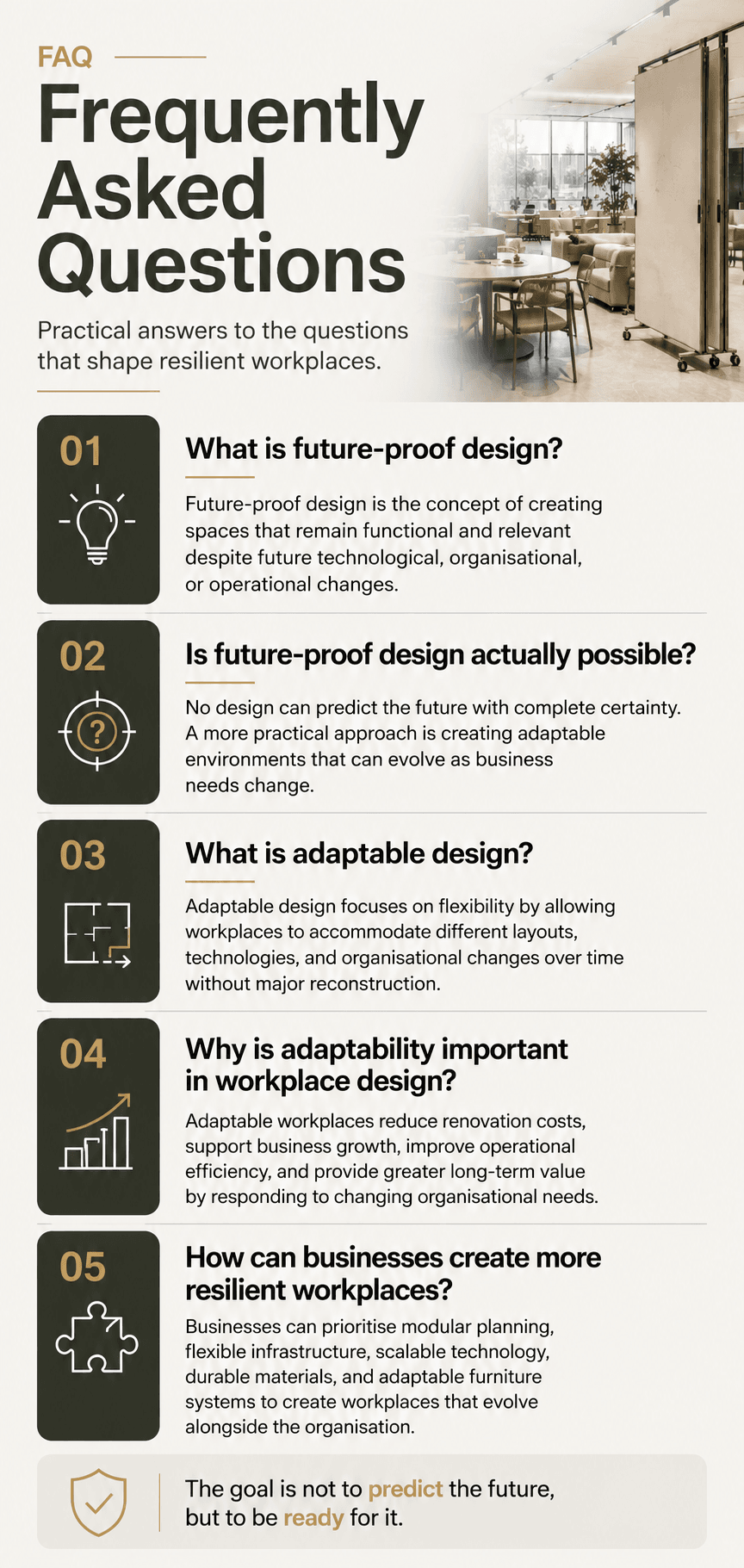
Few phrases have become as popular in recent years as “future-proof design.” Clients request it. Consultants promote it. Industry publications celebrate it. The idea is appealing because it promises certainty in an uncertain world: create a space today that will continue performing for years, regardless of how business, technology, or people evolve.
It sounds reassuring.
Yet there is a fundamental problem.
The future is remarkably difficult to predict.
After decades of delivering workplace and corporate interior projects, one lesson has remained remarkably consistent: organisations rarely change in the ways they expect, but they almost always change.
Rather than asking whether a workplace can be future-proofed, a more valuable question is this:
Can the environment adapt when change inevitably happens?
That distinction fundamentally changes how successful spaces are designed.
Why Future-Proof Design Is Such an Attractive Idea
Every organisation wants its investment to last.
Whether relocating headquarters, renovating an office, or expanding into a new facility, decision-makers naturally want confidence that today’s investment will remain valuable tomorrow.
Future-proof design promises exactly that. It suggests organisations can anticipate future workplace needs and build spaces capable of accommodating them indefinitely. From a financial perspective, this sounds logical.
Nobody wants to redesign an office every few years. Nobody wants to replace expensive infrastructure prematurely. However, the assumption behind future-proofing is that future needs can be predicted with reasonable accuracy.
History repeatedly demonstrates otherwise.
The Future Has Always Been Difficult to Predict
Business history is filled with unexpected change. Few organisations anticipated:
- The rapid rise of hybrid work
- The acceleration of remote collaboration
- The widespread adoption of cloud technology
- Artificial intelligence becoming part of daily work
- E-commerce transforming retail environments
- Significant shifts in employee expectations
Even experienced business strategists, economists, and technology leaders struggle to forecast what organisations will require ten years from now.
Interior design faces the same challenge.
Spaces designed around assumptions that later become outdated often require costly modifications. The issue is not poor design. The issue is believing certainty exists where uncertainty is unavoidable.
Future-Proofing Vs. Adaptability
Although the terms are often used interchangeably, they represent fundamentally different design philosophies.
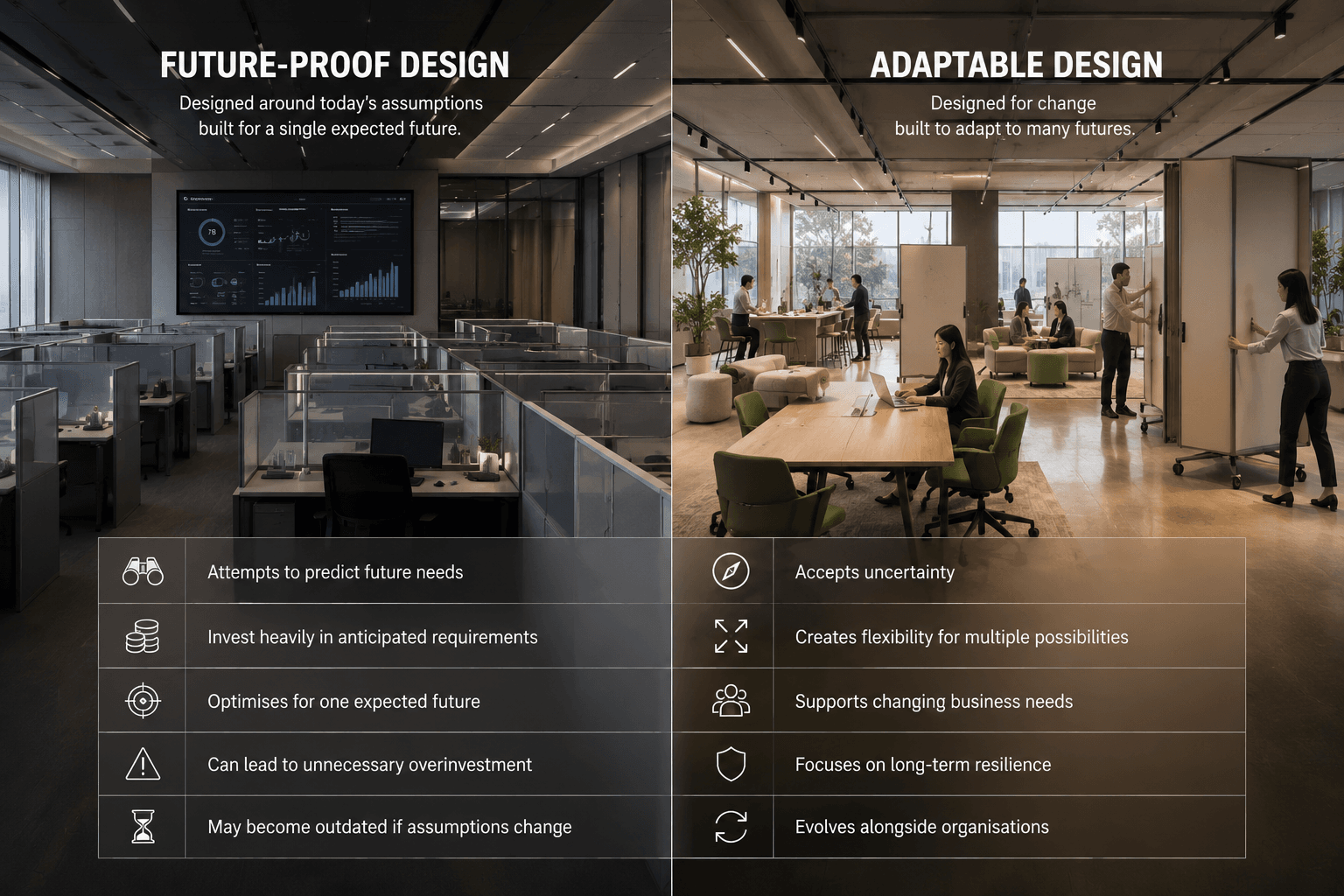
No organisation can accurately predict every future requirement. Instead of designing for one imagined future, adaptable environments prepare for many possible futures.
Why Adaptability Creates Greater Long-Term Value
Rather than attempting to eliminate uncertainty, adaptable design works with it. This means creating environments that can evolve as organisations change.
Examples include:
- Modular planning strategies
- Flexible workspace configurations
- Scalable technology infrastructure
- Easily reconfigured meeting areas
- Furniture systems that support multiple layouts
- Services that allow future expansion
These decisions may appear less dramatic than highly specialised design solutions. However, they often provide significantly greater value over the life of the workplace. The goal shifts from permanence to responsiveness.
Designing for Change Instead of Predicting It
Every organisation evolves.
Businesses hire new employees.
Departments merge.
Technology improves.
Client expectations shift.
Work processes become more digital.
The question is not whether these changes will occur. The question is whether the workplace can accommodate them without major disruption.
A workplace designed around one operating model may struggle as business priorities evolve. Conversely, a workplace designed with flexibility can often support multiple organisational changes without requiring extensive renovations. That flexibility protects both operational continuity and financial investment.
Adaptability Extends Beyond Space Planning
Many people associate adaptable design only with movable walls or modular furniture. In reality, adaptability influences every aspect of the built environment.
Adaptable workplaces often include:
- Infrastructure that supports future technology upgrades
- Lighting systems capable of different working styles
- Flexible power and data distribution
- Furniture that can be repurposed
- Meeting spaces serving multiple functions
- Areas that accommodate organisational growth
Adaptability is not about making everything temporary.
It is about ensuring permanent investments remain useful under changing circumstances.
Can Design Ever Be Truly Timeless?
Another common objective is creating timeless interiors. Many organisations attempt to achieve this by avoiding trends altogether. While longevity is important, timelessness is not achieved by eliminating character. Instead, timeless environments are built upon strong design principles.
Clear planning.
Functional circulation.
High-quality materials.
Thoughtful proportions.
Balanced lighting.
These foundations allow spaces to evolve naturally over time. Rather than redesigning entire environments, organisations can refresh selected elements as needs change.
For example:
- Materials can be refreshed.
- Furniture can be replaced.
- Branding can evolve.
- Technology can be upgraded.
- Decorative elements can change.
When the underlying framework remains effective, these updates become significantly easier and more cost-efficient.
The Financial Cost of Chasing Every Future Possibility
Future-proofing often carries hidden financial risks. Organisations sometimes invest heavily in capabilities designed around hypothetical future scenarios. These may never materialise. As a result, businesses pay today for functionality they may never use.
This can include:
- Oversized infrastructure
- Underutilised technology
- Excessive specialised spaces
- Complex systems requiring unnecessary maintenance
Resources become allocated toward uncertain possibilities instead of current business priorities. A resilient design strategy generally provides stronger long-term return on investment because it allows future decisions to be made when better information becomes available.
Why Resilience Matters More Than Prediction
Perhaps resilience is a more valuable objective than future-proofing. Resilient environments recognise that change is inevitable. Instead of resisting it, they accommodate it.
Characteristics of resilient workplaces include:
- Flexibility
- Scalability
- Simplicity
- Durability
- Operational efficiency
- Ease of maintenance
These qualities allow organisations to respond to changing market conditions without repeatedly rebuilding their workplace. In many cases, resilience ultimately becomes the closest practical equivalent to future-proofing.
Designing Workplaces That Grow With Organisations
Successful workplaces are rarely static. They mature alongside the organisations that occupy them.
Businesses develop new strategies.
People work differently.
Technology reshapes collaboration.
Markets create new demands.
Rather than viewing change as a design failure, adaptable environments recognise it as evidence of business growth. The strongest projects do not eliminate uncertainty. They embrace it.
The Closest Thing to Future-Proof Design
After decades of observing how buildings and workplaces evolve, one lesson remains clear. The projects that age best are rarely those attempting to predict the future with precision.
They are the projects that accepted uncertainty from the beginning.
They created room for adaptation.
They invested in flexibility instead of rigid assumptions.
The future cannot be designed with certainty.
But workplaces can be designed to respond to it. That may be the closest thing to future-proof design that truly exists.
FAQ