Budgeting a Phased Office Fit-Out in Malaysia: What to Prioritise First
A practical guide for Malaysian businesses planning corporate interiors in stages, with clearer decisions on where to spend early, where to defer, and how to avoid costly rework as the company grows.
Title: Budgeting a Phased Office Fit-Out in Malaysia: What to Prioritise First
Subtitle: A practical guide for Malaysian businesses planning corporate interiors in stages, with clearer decisions on where to spend early, where to defer, and how to avoid costly rework as the company grows.
*
In today’s fast-paced business environment, designing and building a new corporate headquarters is a significant financial milestone. For many Malaysian companies, the traditional “all-or-nothing” approach to an office fit-out—where every desk, feature wall, and boardroom is built out on day one—is becoming a thing of the past. Uncertainty around growth projections, coupled with shifting workplace models, has made preserving capital more critical than ever.
Enter the phased office fit-out. By sequencing your investment, your company can build the workplace it needs today, while keeping options open for tomorrow. However, breaking a build into stages requires strategic corporate interior planning. You need clearer decisions on where to spend your Ringgit early, where to pause, and how to structure your space to avoid paying twice. This guide will walk you through how to construct a practical, future-ready office in stages without compromising on professionalism or staff experience.
Why More Malaysian Companies Are Choosing Phased Office Fit-Outs
The corporate landscape in Malaysia has fundamentally shifted. The rapid adoption of hybrid work across the Klang Valley and other major hubs means that predicting exactly how many employees will be in the office on any given Tuesday is uniquely challenging. As a result, businesses are increasingly reluctant to sign off on massive upfront capital expenditures based on speculative headcount assumptions.
A phased fit-out directly addresses this uncertainty. Rather than building rows of empty desks for a future workforce that may prefer to work remotely, companies are dividing their renovations into manageable tranches. This strategy aligns capital expenditure with actual cash flow and proven space utilisation. It allows businesses to test how their teams use the space in real-time, measure attendance patterns, and only commit funds to expansion when the demand truly justifies it. For fast-growing local enterprises and multinational regional offices alike, this cautious yet deliberate approach is the ultimate risk mitigation tactic.
What a Phased Fit-Out Strategy Actually Means
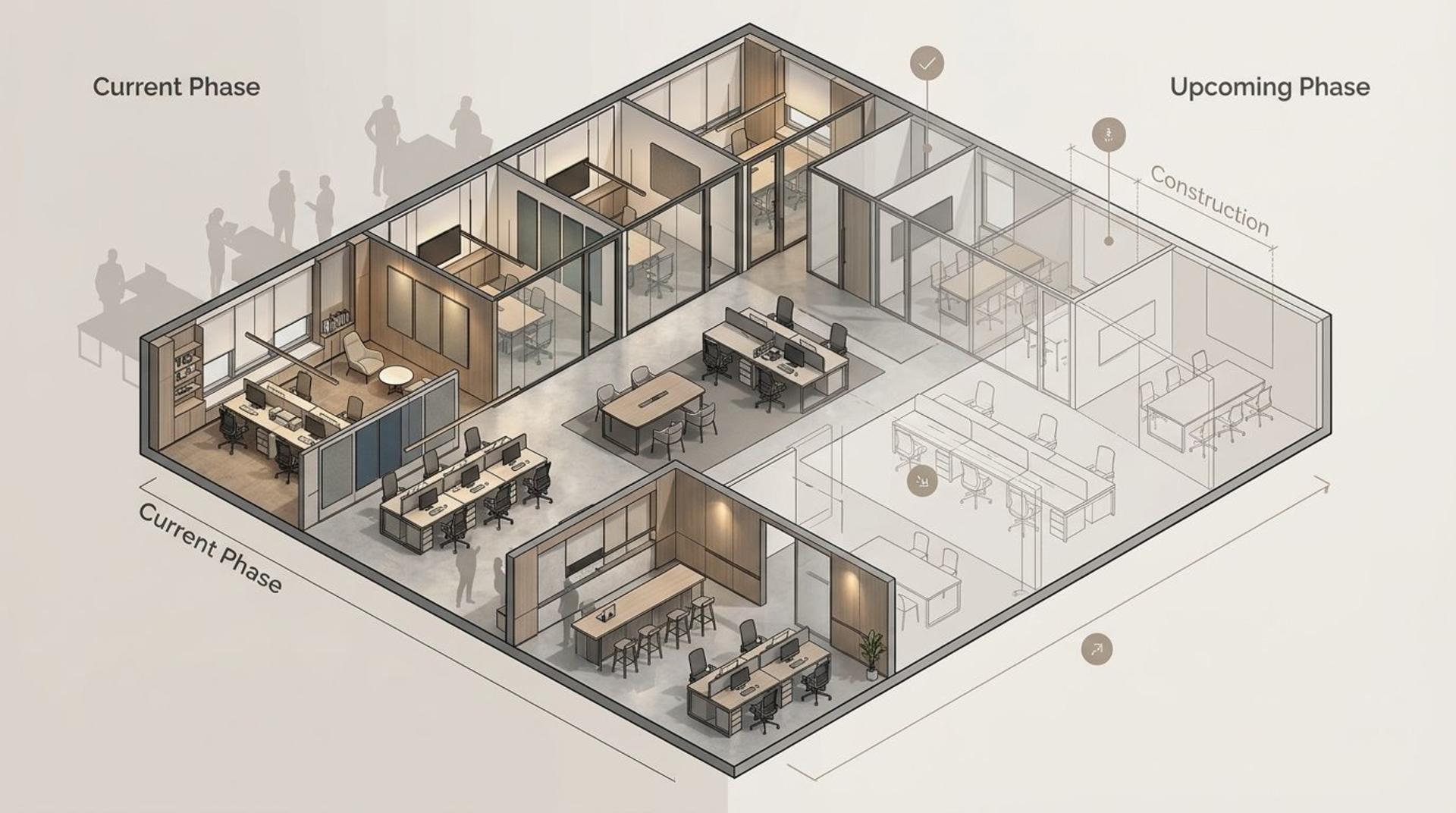
To be clear, a phased fit-out does not mean moving your team into an active, chaotic construction site. Instead, it refers to a deliberate timeline of design and installation where the initial phase delivers a fully functional, complete-looking workspace. Subsequent phases are executed at later dates to unlock new zones, upgrade aesthetics, or expand capacity—often over a weekend or outside of standard working hours to minimise operational disruption.
At its core, it is about shifting from a capital-heavy launch to an agile rollout. The first phase focuses on locking in the "enabling works" so the office can operate safely and efficiently from day one. Future phases usually tackle the fit-out of unused floor space or the addition of premium finishes once business growth milestones are hit. This transforms your real estate strategy from static overhead into a dynamic asset that moves in tandem with your organisation.
Start with Business Priorities, Not Just Space Planning
The most successful staged fit-outs begin in the boardroom, not on the architect’s drafting table. Space planning is only effective when it sits on a foundation of solid business objectives. Before dividing your budget, look at your organisation's strategic horizon. Are you planning an aggressive hiring spree in sales over the next twelve months? Has your tech team transitioned permanently to a split-week hybrid model?
Rather than aiming to fill the square footage, ask yourself what the business must achieve in the next year. If collaboration is currently a major bottleneck, then setting aside budget for team-based spaces should take precedence over individual working pods. A phased approach gives you the flexibility to tie your building timelines directly to business timing, ensuring you only engage contractors when your operational roadmap dictates the need for more space or specific functions.
The Non-Negotiables: Infrastructure, Compliance, and Core Function
When parsing out your Phase 1 budget, the golden rule is to spend first on things that are inherently hard to undo or upgrade later. It can be tempting to allocate funds toward a beautiful client-facing lobby, but the most critical early investments happen behind the walls and above the ceilings.
Your initial budget must comprehensively cover critical mechanical and electrical (M&E) capacity. This includes your core electrical distribution, primary data cabling, server room infrastructure, and central air-conditioning ducting. Securing the IT backbone early guarantees that future expansions are simply plug-in affairs rather than massive rewiring headaches.
Equally critical is the local compliance layer. A phased fit-out will stall entirely if the first stage runs afoul of regulatory standards. In Kuala Lumpur and across Malaysia, adherence to the Uniform Building By-Laws (UBBL), the expectations of the Department of Occupational Safety and Health (DOSH), and strict building management rules cannot be deferred. Proper fire safety systems, smoke control, accessible exit routes, and initial M&E tie-ins must be fully compliant for the occupied zone before you can obtain your operational approvals.
What to Prioritise in Phase One
With infrastructure secure, Phase 1 spending inside the visible workspace should focus squarely on utility and user experience.
Given Malaysia’s distinct tropical climate, air-conditioning and humidity control are absolutely not cosmetic considerations—they are core operational risks. Your earliest practical design moves must prioritise a stable cooling strategy and strong dehumidification. Heavy daily use in perimeter zones and around pantries or tea-points often results in rapid condensation and wear, so investing upfront in durable, moisture-tolerant materials in these areas will save you ongoing maintenance costs.
Next, adapt to the reality of the modern workday. Most progressive Malaysian offices are now designing around hybrid models rather than assigning full-time permanent desks to every employee. Therefore, Phase 1 should heavily prioritise meeting room capacity and collaboration spaces over large, enclosed executive suites. Employees and visiting clients judge a modern workspace by its ability to support fluid work processes. Virtual-meeting-ready rooms, private soundproof phone booths for quick calls, and plug-and-play agile workstations are absolute essentials. If these are missing, the office will hinder productivity from the start.
Interestingly, wellness and comfort upgrades also rank as high-value Phase 1 investments. Directing funds toward ergonomic seating, acoustic relief, quiet concentration zones, and ensuring access to natural light will profoundly impact staff retention and daily usability. These investments support productivity far more reliably than vanity design elements.
What Can Be Deferred Without Compromising Operations
Once the core infrastructure, compliance routines, and functional collaboration spaces are locked in, you can easily identify what can be pushed to Phase 2 or 3. The rule of thumb is: if it only serves an aesthetic purpose and doesn't limit a team’s ability to work safely and effectively, it can wait.
Highly bespoke decorative features, intricate feature walls, complex ceiling geometries in non-client zones, and premium branded styling in secondary areas are prime candidates for deferral. Similarly, avoid over-investing in mass rows of fixed desks if your current team doesn't fill them. Let the unused zones of your floor plan remain as "white space" or simple, loosely furnished breakout areas. You can activate these blank canvases as headcount firms up.
How to Budget for Growth Without Overbuilding Early
The smartest cost-saving move a veteran project manager will share is that the cheapest Phase 1 is the one that avoids expensive demolition in Phase 2. The key to budgeting for long-term growth is agility.
Resist the urge to anchor your layout with rigid, heavy built-in cabinets or complex bespoke joinery. If business divisions merge or scale unexpectedly, overly customized structures can quickly trap capital in parts of the office that become obsolete. Instead, funnel your budget into broad, open plan setups configured with modular partitions and movable furniture.
By creating fluid zones that can be reconfigured overnight, you eliminate the need to tear down plasterboard walls and reroute ventilation just to fit ten more people into a department. Designing for flexibility means your future expansion stages only require the procurement of more desks and soft furnishings, drastically shrinking future contracting costs.
Common Fit-Out Budgeting Mistakes to Avoid
The most frequent misstep decision-makers make is treating an office fit-out as a single, monumental design exercise rather than a continuous sequence of decisions tied to business evolution. Failing to separate the "needs" from the "wants" early often results in a front-loaded budget that runs dry before the enabling works are complete properly.
Another common mistake is misallocating initial capital to legacy hierarchies—such as overbuilding massive private offices for directors—while underfunding the communal technology and server capacities that keep operations running. A successful phased rollout demands discipline. You must resist the pressure to make the space look perfectly styled at the expense of its backbone.
How Landlord Requirements and Building Rules Affect Cost
In Malaysia, particularly within premium office towers in Kuala Lumpur and Penang, building management constraints heavily dictate your budget and timeline. Every landlord enforces a unique set of fit-out guidelines that will directly hit your bottom line.
For example, connecting to the building's central fire alarm, sprinkler system, and chilled water lines typically requires you to use the landlord’s Nominated Sub-Contractors (NSC). These contractors often charge premium rates over which you have very little negotiating power. Additionally, loud hacking, drilling, or material deliveries are strictly confined to nights or weekends, generating immediate overtime labor costs.
Furthermore, you will be required to lodge a substantial, refundable security deposit before any work commences to cover potential damages to common areas. When budgeting a phased approach, keep in mind that landlord approvals and NSC tie-ins may be required repeatedly for each phase, so planning the bulk of your ceiling and safety interfaces during Phase 1 makes sharp financial sense.
Building Contingency into Your Office Fit-Out Budget
No matter how flawlessly your design team plans the rollout, office fit-outs inherently carry a degree of unpredictability. Uncovering previous tenant damages, unexpected material price hikes, or delayed statutory approvals can threaten the financial viability of your project.
For a phased approach, a robust contingency budget is non-negotiable. Standard industry practice recommends setting aside 10% to 15% of the total estimated project cost specifically for unforeseen variables. Crucially, this reserve should be ring-fenced to ensure core infrastructure and compliance issues can be resolved rapidly if early complications arise, without having to cannibalise funds earmarked for essential staff amenities.
How Good Design Reduces Rework Across Future Phases
Achieving a seamless transition from one phase to the next relies entirely on intelligent foresight during the initial spatial planning. Good design acts as an insurance policy against future rework.
If Phase 1 is designed with a deliberate modular mindset, you won't need to rip up the carpets or pull down the ceilings when it’s time to grow. Using raised flooring for accessible cabling, installing a ceiling grid that easily accepts additional lighting or AC vents, and choosing a standardized furniture system across the board enables rapid, clean scaling. Instead of initiating another messy construction cycle, scaling up eventually feels less like a demolition project and more like a simple furniture delivery.
A Smarter Way to Sequence Office Investment
Transitioning a Malaysian business into a new workspace doesn't have to be a high-stakes, all-at-once gamble. By adopting a phased office fit-out, companies can intelligently bridge the gap between their current financial realities and their future ambitions.
The secret lies in rigorous prioritization: locking down hard-to-change infrastructure and safety compliance first, accommodating the reality of hybrid workflows with versatile meeting solutions, and investing in wellness items that tangibly impact daily productivity. By consciously deferring heavily bespoke aesthetics and immovable structures, you preserve vital capital while creating a durable, professional environment. Ultimately, sequencing your interior investments ensures your office serves as a true catalyst for growth, capable of scaling seamlessly right alongside your people.